It’s Not Just About Tracking: How Check-In Apps Helped My Family Grow Closer
Imagine this: you’re sitting at the dinner table, asking your child, ‘How was school?’ and getting the usual one-word reply. You want to be involved, but don’t know where to start. I felt the same—until we began using a simple learning check-in app together. It didn’t just show progress in math or reading; it opened daily conversations, built trust, and turned small moments into meaningful connections. This isn’t about data—it’s about staying close when life gets busy. And honestly, if you’ve ever felt like you’re parenting from the sidelines, this might be the gentle nudge you’ve been waiting for.
The Quiet Gap Between Parents and Kids
Let’s be real—most of us want to be the kind of parent who really *gets* what’s going on in our child’s day. Not just the facts, but the feelings. We want to know when they’re proud, when they’re frustrated, when they’re quietly struggling. But too often, the conversation stops at ‘Fine’ or ‘Okay.’ And that’s not because our kids don’t want to talk—it’s because we don’t always give them the right door to walk through.
I remember nights when I’d try to dig deeper. ‘What did you learn today?’ would be met with a shrug. ‘Did anything fun happen?’ got a vague, ‘I guess.’ It wasn’t their fault. I was asking broad questions at the end of a long day, when everyone was tired and hungry. The emotional window was tiny, and I was missing it every time. I started to wonder—was I becoming the kind of parent who only shows up for the big moments, like report cards or parent-teacher conferences?
And I’m not alone. So many moms I talk to feel the same quiet ache—the sense that they’re missing out on the little things that actually matter. We get school emails with grades and attendance, but those numbers don’t tell us if our child felt seen in class, if they finally raised their hand, or if they’re starting to believe in themselves. That gap—between caring deeply and knowing how to connect—is real. It grows slowly, quietly, until one day you realize you’re not as close as you used to be.
But here’s the good news: you don’t need a perfect schedule or endless energy to close it. Sometimes, all it takes is one small, consistent thing—like a two-minute check-in—to open the door.
How a Simple App Changed Our Evenings
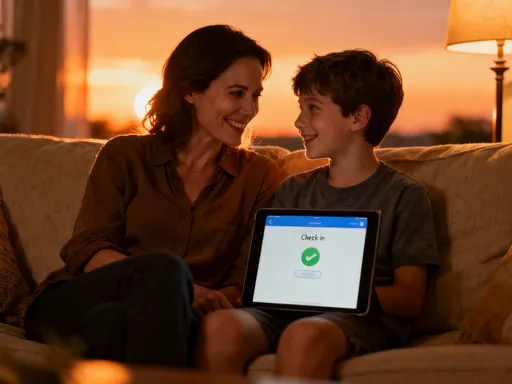
It started almost by accident. A friend mentioned she used a check-in app with her daughter—not for grades, but just to stay in touch. I was skeptical at first. Another screen? Another notification? But she said it actually *reduced* stress in their home. Curious, I looked into it and found one that felt simple, warm, and private—no public scores, no competition. Just a daily prompt for my son to reflect on his day.
We began one Sunday night. I showed him the app and said, ‘This isn’t homework. It’s just a little note to yourself—and to me—about how your day felt.’ He picked a face that matched his mood, rated his effort, and typed one sentence: ‘I liked art today.’ That was it. But the next morning, I mentioned it casually: ‘You said you liked art—what did you make?’ And for the first time in weeks, he told me a full story. About the colors he chose, how his friend laughed at his drawing, how the teacher hung it up.
That small exchange changed everything. The app wasn’t doing the talking—it was giving us a starting point. Over the next few weeks, I noticed patterns. On days he gave high effort but low mood, he was often dealing with group work or loud classrooms. On days he felt proud, it wasn’t always about grades—it was about trying something hard, or helping a classmate. I stopped asking, ‘How was school?’ and started with, ‘I saw you gave it your all today—what took the most courage?’
And slowly, the silence gave way to sharing. He began telling me things before I even opened the app. ‘Mom, I didn’t pick the happy face yesterday because math was hard, but I figured it out.’ That kind of honesty didn’t come from pressure—it came from feeling safe, seen, and supported. Our evenings didn’t become perfect, but they became more *real*. And that, I’ve learned, is where connection grows.
Turning Data Into Dialogue
When I first heard the word ‘data’ in relation to parenting, I cringed. It sounded cold, clinical—like we were turning childhood into a spreadsheet. But what I’ve realized is that not all data is impersonal. Some of it carries emotion, effort, and growth in ways words sometimes can’t.
The check-in app we use doesn’t ask, ‘What grade did you get?’ It asks, ‘How proud are you of your work today?’ or ‘What was one thing that felt good?’ These aren’t performance questions—they’re reflection questions. And the answers, even when they’re just emojis or short phrases, open doors to deeper talks.
One day, my son selected a green smiley face—middle of the road. I asked, ‘What made it a green kind of day?’ He said, ‘I didn’t do great, but I didn’t give up.’ That simple sentence told me more than any quiz score ever could. It told me about resilience. About self-awareness. About the quiet strength he was building.
Another time, he picked the ‘proud’ badge after a science presentation. I said, ‘Tell me about that pride.’ And he lit up. ‘I was scared, but I spoke the whole time. And I didn’t mess up!’ That moment became our highlight of the week. We celebrated with his favorite dessert, not because he aced it, but because he faced his fear.
The magic isn’t in the app—it’s in how it helps us *respond*. Instead of jumping to solutions or praise, I’ve learned to listen first. ‘That sounds tough.’ ‘I’m so glad you shared that.’ ‘I see how hard you worked.’ These phrases have replaced, ‘Why didn’t you get an A?’ or ‘You should’ve tried harder.’ And the shift in our relationship has been profound. He doesn’t hold back because he’s afraid of judgment. He shares because he knows I’m on his side.
Building Trust One Check-In at a Time
Trust isn’t built in big moments. It’s built in the small, repeated ones—like showing up, day after day, even when nothing dramatic is happening. That’s what our check-in routine has become: a quiet promise that I’m here, I care, and I’m listening.
At first, my son treated the app like a chore. But over time, something shifted. He started adding extra details—‘I helped Jake with his math,’ or ‘I read five pages without stopping.’ He wasn’t doing it for rewards. He was doing it because he knew someone would see it, remember it, and care.
And I made sure I did. I’d reference his check-ins in real life: ‘You said reading felt easier this week—want to pick a new book together?’ or ‘You mentioned feeling nervous before gym—do you want to practice the game at home?’ These weren’t grand gestures. They were tiny acts of attention. But they added up.
What surprised me most was how he began initiating conversations. One afternoon, he said, ‘Mom, can I tell you about my check-in before I log it?’ He wanted to talk first, then write it down. That moment hit me hard. This wasn’t just a tool for me to stay informed—it was becoming a safe space for him to process his day.
He also started asking me questions. ‘Do you have a check-in at work?’ I laughed and said, ‘Not really, but maybe I should.’ So now, sometimes, I share my own ‘check-in’—what I’m proud of, what was hard. It’s not about being perfect. It’s about showing him that everyone has ups and downs, and that’s okay.
Trust grows when kids feel heard, not fixed. When their emotions aren’t treated as problems to solve, but as experiences to understand. The app didn’t teach him to open up—it created a rhythm where opening up felt safe, normal, and valued.
Making Progress Visible—Without the Pressure
One of the hardest things for kids is when progress feels invisible. They put in effort, but if there’s no test, no grade, no trophy, it’s easy to think, ‘Did I even get better?’ That’s where the check-in app has quietly changed the game.
The app shows a simple timeline of his daily reflections. No averages, no rankings—just a visual of how he’s feeling over time. A few weeks in, he noticed something: ‘Mom, look—my “proud” badges are getting more frequent.’ I leaned in. ‘What do you think changed?’ He thought for a minute. ‘I think I’m trying more. And I’m not scared to fail as much.’
That was a milestone. He wasn’t comparing himself to anyone else. He was seeing his own growth, in his own terms. And that kind of awareness is powerful. It builds confidence from the inside out.
I’ve used those visuals not to push him, but to encourage him. ‘You’ve been consistent with your reading check-ins—want to set a fun goal, like finishing a chapter book?’ He chose a graphic novel he’d been eyeing. We celebrated when he finished it—not with a prize, but with a family read-aloud of his favorite part.
The app doesn’t replace teachers or report cards. But it gives him a mirror—a way to see himself beyond grades. He’s starting to recognize patterns: when he sleeps well, his focus improves; when he takes breaks, he solves math problems faster. These aren’t lectures from me—they’re discoveries he’s making on his own.
And that’s the kind of learning that lasts. It’s not about perfection. It’s about progress, self-awareness, and the quiet pride that comes from knowing you’re growing.
When Life Gets Busy, the App Keeps Us Connected
Let’s face it—life doesn’t slow down. There are weeks when I’m traveling for work, when my partner is swamped with deadlines, when the kids have back-to-back activities. In those seasons, it’s easy for connection to slip.
But the check-in app has become our soft tether. Even when I’m in another city, I can see his daily reflection. A quick tap shows me he’s okay, that he’s trying, that he had a win. And I can send a one-line reply: ‘So proud of you for not giving up.’ He tells me it makes him feel like I’m still there, even when I’m not.
One evening, he logged a check-in while I was at the airport. He wrote, ‘I got picked for the science team!’ I messaged back, ‘That’s amazing! Tell me everything when I get home.’ That night, he saved his story for me. He didn’t tell his dad or his sister first—he waited. Because he knew I’d be present, even if I was delayed.
And it works both ways. When I’m having a tough day, I’ve started sharing my own reflections. ‘Today was hard, but I kept going.’ He’ll reply, ‘You got this, Mom.’ That kind of mutual support—it’s priceless.
The app doesn’t replace face-to-face time. But it keeps the thread of connection alive during the messy, unpredictable parts of life. It’s not about screen time—it’s about heart time. And sometimes, a little digital nudge is all it takes to say, ‘I’m here. I see you. I care.’
More Than an App—A New Family Habit
Here’s the truth I didn’t expect: we don’t even need the app as much anymore. The notifications are off. The badges don’t matter. But the habit remains.
Now, at dinner, I don’t ask, ‘How was school?’ I say, ‘What part of your day felt good?’ Or, ‘What took the most effort?’ And he answers—fully, honestly, without prompting. Sometimes, he asks me the same. We’ve created a rhythm of reflection, of presence, of mutual care.
The app was the spark, but the real change was in our mindset. We stopped seeing daily life as something to rush through and started seeing it as something to notice, to share, to grow from. We’re not perfect. Some days are still rushed, tired, or tense. But now, we have a way back to each other.
Technology often gets blamed for pulling families apart. But this experience has taught me that some tools, when used with heart, can actually bring us closer. They don’t have to be flashy or complex. They just have to create space—for listening, for understanding, for love.
If you’re feeling disconnected, if you’re tired of one-word answers, if you want to know your child deeper—start small. Try a daily check-in. Use an app, a notebook, a sticky note on the fridge. It doesn’t matter how you do it. What matters is that you show up. Because connection isn’t built in grand gestures. It’s built in the quiet, consistent moments when we say, without words, ‘I’m here. I’m listening. You matter.’ And sometimes, a little technology can help us say it more clearly than ever before.